A candid conversation with R. Buckminster Fuller


Photograph by Fred Blocher for Kansas City Star, 1978

Self-Disciplines, excerpt from the 1972 Playboy Interview

1. Use myself as an experiment to see what, if anything, a healthy, young male human of average size, experience, and capability with an economically dependent wife and new born child, starting without capital or any kind of wealth, cash savings, credit or university degree could effectively do that could not be done by great nations or great private enterprise to lastingly improve the physical protection and support of all human lives.

2. Commit all of my productivity toward dealing only with the whole planet Earth and all its resources and cumulative know-how. Observation of my life to date shows that the larger the number for whom I work, the more positively effective I become. Thus, it is obvious that if I work always and only for all humanity, I will be optimally effective.

3. Seek to do my own thinking, confining it to only experientially gained information.

4. Seek to accomplish whatever is to be attained in such a manner that the advantage attained would never be secured at the cost of another or others.

5. Seek to cope with all humanly unfavourable conditions by searching for the family of relevant physical principles involved.

6. Reduce my inventions to physically working models and must never talk about the inventions until physically proved or disproved.

7. Seek to reform the environment, not the humans. I am determined never to try to persuade humanity to alter its customs and viewpoints.

8. Never promote or sell either my ideas or artefacts or pay others to do so. All support must be spontaneously engendered by evolution’s integrating of my inventions with the total evolution of human affairs.

9. Assume that nature has its own gestation rates, not only for the birth of each new biological component, but also for each inanimate technological artefact.


10. Seek to develop my artefacts with ample anticipatory time margins so that they will be ready for use by society when society discovers - through evolutionary emergencies - a need for them.

11. Seek to learn the most from my mistakes.

12. Seek to decrease time wasted in worried procrastination and to increase time invested in discovery of technological effectiveness.

13. Seek to document my development in the official records of humanity by applying for and being granted government patents.

14. Above all, seek to comprehend the principles of eternally regenerative universe and discover how humans function in these principles.

15. Seek to comprehend the full gamut of production tool capabilities, energy resources, and all relevant geological, meteorological, demographic, and economic data.

16. Seek to operate only on a do-it-yourself basis and only on the basis of intuition.

17. Plan for my design science strategies to advantage the new life to be born on Earth, life born unencumbered with the conditioned reflexes so prevalent today.

18. Commit whole-heartedly to the above and pay no attention to "earning a living" in humanity’s established economic system, yet find that my family’s and my needs are provided for by seemingly pure happenstance and always only in the nick of time.

R. Buckminster Fuller, Specialized in generality via the Buckminster Fuller Institute

L’image volée


Once again Thomas Demand has ventured into curating and once again the outcome is admirable. As was the case with Model Studies, he chose a subject that contextualizes his own artistic practice without necessarily telling too much about it. He also chose an interesting team to work with. Fellow artist Manfred Pernice designed the show. Fellow artist John Baldessari conceived the billboard and poster campaign in the city.


Installation views. Photographs Delfino Sisto Legnano Studio via Fondazione Prada

The curatorial sequence develops thanks to the careful interaction between artworks, space and color in the Fondazione Prada's North gallery. [I refer to their website for a good general description]. When visiting the show, we see everything for what it is and there seems to be no disguises: the drywall was laid on the preexisting industrial floor; the skirting is sometimes present and sometimes absent; the different colours and the many materials on which they are laid better articulate the three approaches to the theme. Even the labels, always a disturbing element when visiting exhibitions, are placed appropriately. 


Labels. Photographs Mariana Siracusa

The show is a great example of well-coordinated efforts to compose a coherent narrative. As all those who have worked on exhibitions know, putting up a show is usually teamwork. There is an institution, a curator, a curatorial team of researchers, an exhibition designer, a graphic designer, a light designer, a coordinator, not to mention the technicians who actually build the space. Their expertise should come together into a consistent outcome but more often than not the details reveal problems. This is not the case here.

Installation view. Photograph Delfino Sisto Legnano Studio viFondazione Prada

There is only one element that does not live up to the feeling of extreme care that the exhibition conveys. And that is the publication that accompanies the show. It is a nice exhibition catalogue where nothing is missing. It is a good reminder of what the visitors saw in the galleries, but nothing more. The essays by renowned critics, the conversation with the exhibition designer, the case studies, the clear chapters, the commented index of all selected works, and the bibliography somehow don't come together into a convincing and unitarian object. Translating a spacial experience into two-dimensional pages is not an easy task. It is the reason why publications require a different attitude both by the curator and the reader/visitor.

Exhibition poster by John Baldessari
   

Spazio recommends: This was tomorrow


Drawings are thoughts and each architect has a distinctive way of expressing them. Comparing drawings is like doing a forensic handwriting analysis. In the aftermath they reflect different desires, dreams and ambitions for the future. The exhibition This was Tomorrow at the SAM in Basel, up until May 5th, gives the great opportunity to have a glimpse of what future meant between 1953 and 1978 for twelve renown architects. The curators Markus Lähteenmäki, Manuel Montenegro and Nicholas Olsberg selected the material from the Drawing Matter Collection.


The reference to This is Tomorrow, the 1953 exhibition at the Whitechapel Art Gallery, is explicit. The catalogue is shown in gallery one next to the intro text. In the same room Le Corbusier, Hejduk and Stirling and Gowan face each other.

Le Corbusier, Baghdad Olympic Stadium, 1953-1965. Photograph Mariana Siracusa

John Hejduk, The Extro-intro House on the Third Model - Projection Triptych, 1975. Photograph Mariana Siracusa

James Gowan, The Expandable House, 1956. Via Drawing Matter

In gallery two we find Ugo La Pietra, Constant, Walter Pichler and Hans Hollein, Michael Webb, Superstudio, and R. Buckminster Fuller. Each of them had an idea of what the future would or should look like and their drawings seem to conform to a very specific agenda. For Superstudio architecture would fit into a geometrical grid, for Pichler and Hollein cities would be plasticly shaped to reconcile with the land, for Fuller the inventions of a scientific mind would change the way we live. There seems to be no hesitation, their visions are very clear.

Ugo La Pietra, La Cellula Abitativa, 1972. Via Drawing Matter

Superstudio, Istogrammi d'Architettura, 1969. Via Drawing Matter

Walter Pichler, Untitled study sketch, 1961-1963. Via Drawing Matter

Hans Hollein, Stadt, 1960. Via Drawing Matter

R. Buckminster Fuller, Bauwerk in Kugel- oder Kugelabschnittform, 1958. Via Drawing Matter

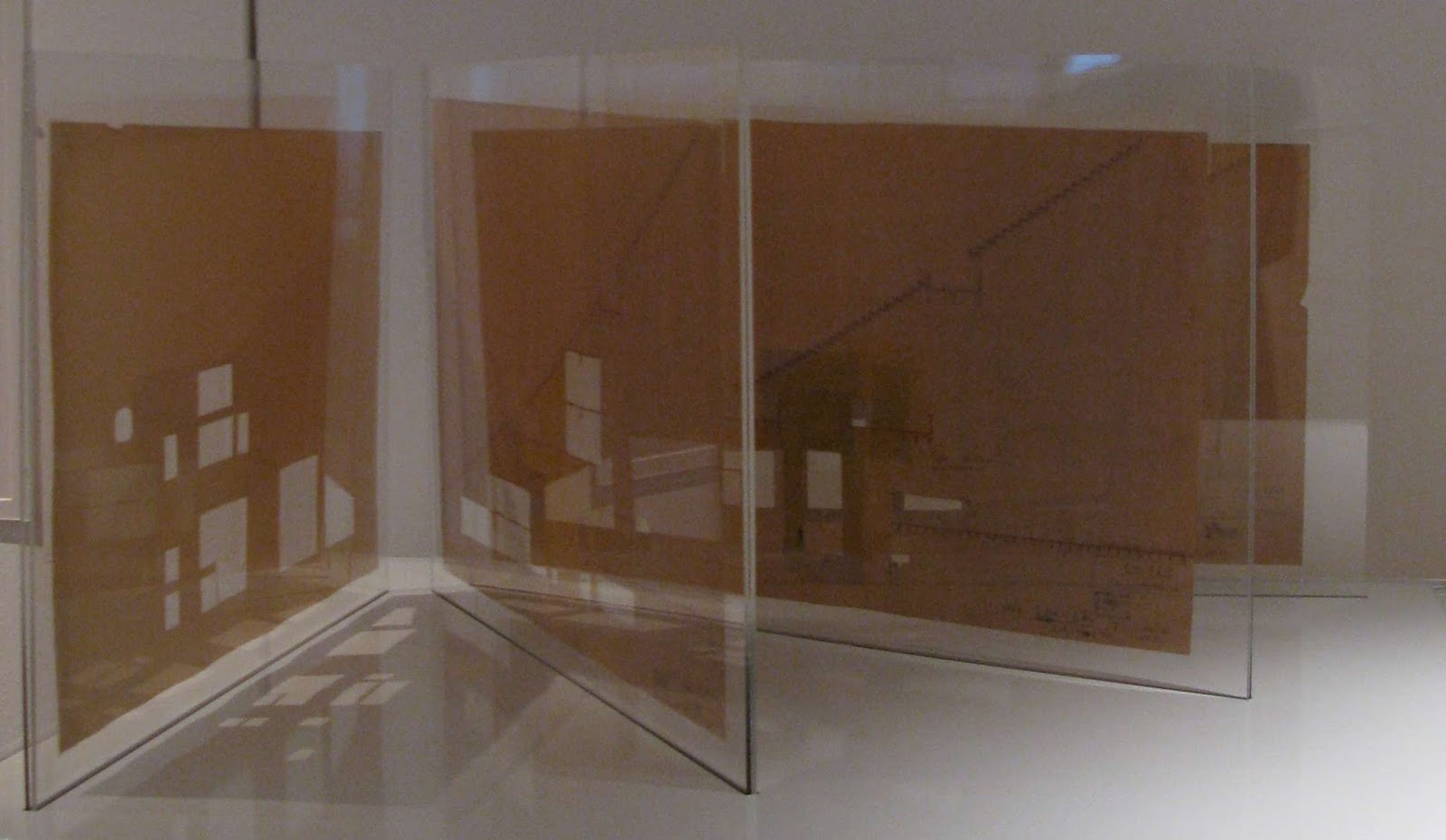
On the contrary, Alvaro Siza and Louis Kahn's drawings show an arduous and meticulous search for something that they still could not envision. Every detail was part of a patient quest. Siza explored the many spatial possibilities of each of them by filling every centimetre of paper. Kahn instead needed to see the outline of the entire building to focus on a specific fragment. 


Louis Kahn, Kansas City Office Building, 1973. Photograph Mariana Siracusa

The final gallery is devoted to Aldo Rossi. It is a black dark room that reflects the ability of the architect to absorb and include all that the past has produced to create bright new visions.

Aldo Rossi, Urban Fragment, 1977. Via Drawing Matter

It does not matter that reality took over and that the future turned out to be a very different thing. These dreams are still relevant.


Spazio recommends: Objection! Protest by Design

Up until May 29th, this Vitra Design Museum exhibition shows the informal structures and designs that were created during the Umbrella Movement, a spontaneous student protest that erupted in Hong Kong on September 2014 as a reaction to proposed changes in the electoral process.

Lennon Wall, Hong Kong. Photograph Jesse Howard

I found of great interest the remarks on public/private space. "When we go into the street and have to live there without a well-defined space for resting, the distinction between public and private space disappears, and the space has to be redefined. [...] Activities one usually performed in private suddenly come into public view. Occupiers had to think creatively and find ways to carry out basic human behaviours. if we view this as a demonstration of what is essential to our way of living now, the informal designs show a response to what the public needs."


Study Room, Hong Kong. Photograph David Leung/MIRO

Crossroad stairs, Hong Kong. Photograph Community Museum Project

Tents, Hong Kong. Photograph David Leung/MIRO

Informal Shrine, Hong Kong. Photograph King-Chung Siu

Parreno's Water Lilies


There is probably no need to price again the Fondation Beyeler building in Basel. What I would like to remark instead is the ability of certain artists – in this case Philippe Parreno – to listen what both interior and exterior spaces say and use their work to challenge them.